
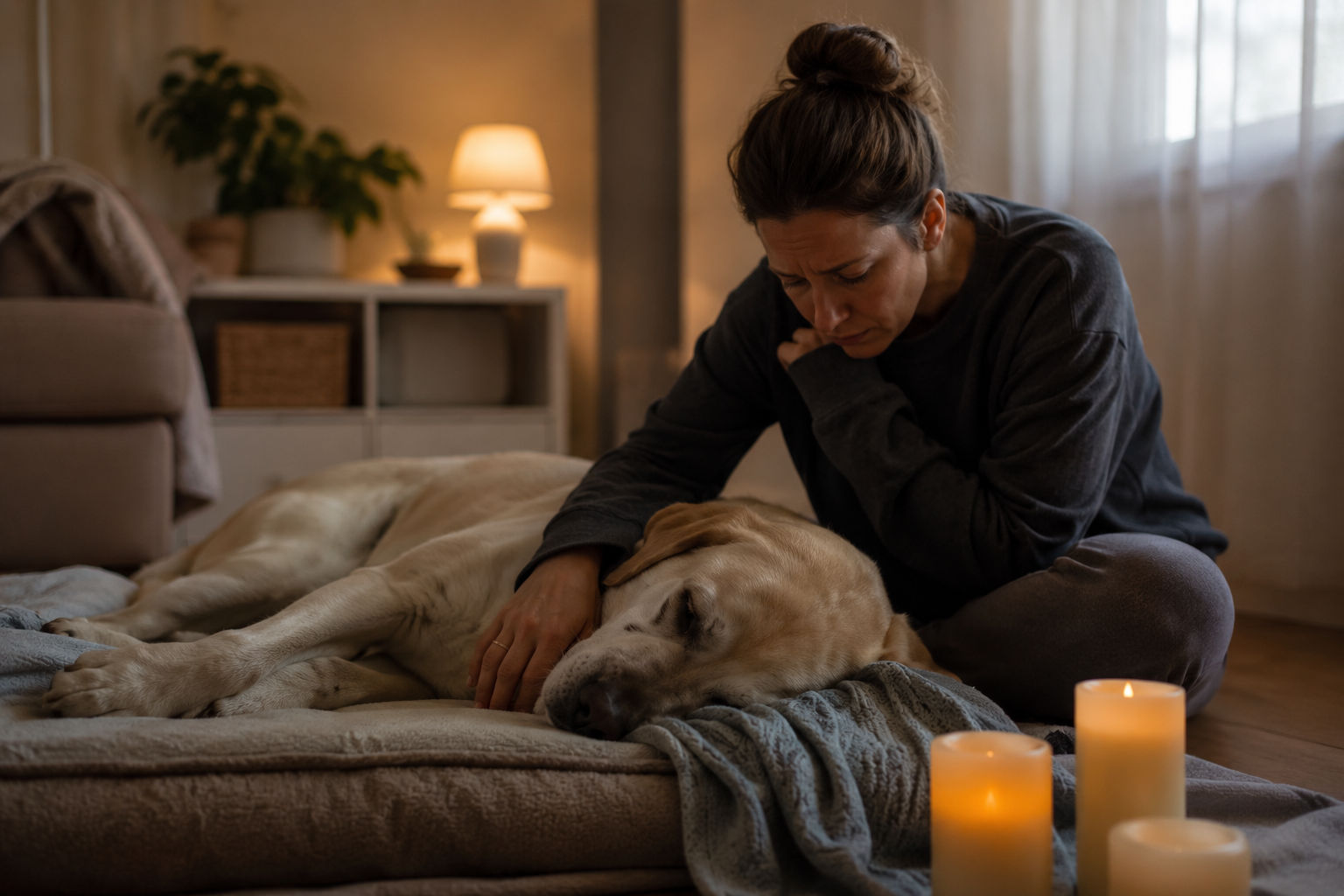
 If you’re reading this in the middle of the night, or in the immediate aftermath of your pet passing at home, the most important thing to know is this:
You don’t have to do anything in the next hour.
There’s no medical urgency. Nothing bad will happen if you wait. Your pet is no longer in pain or distress. You can sit with them. You can cry. You can call someone. You can just be still for a while.
This guide is meant to walk you through what to do, in the order it actually needs to happen — not the panicked order your mind may be suggesting. We’ll start with the first hour.
First: confirming death
Most pets pass clearly. There’s no breathing, no heartbeat, no response to gentle touch. Their eyes are typically open. Their body is still.
If you’re unsure, the things to look for:
- No breathing. Watch their chest and abdomen for several minutes. Pets in deep sleep breathe shallowly but visibly. A pet who has passed will show no chest movement at all.
- No heartbeat. If you’re comfortable, you can place your ear or hand against their chest behind the elbow to feel for a heartbeat. There will be none.
- No response. Gentle touch to the eye (the corneal reflex) typically produces no response in a pet who has passed. Their muscles will be relaxed but may begin to stiffen over the first few hours.
If you have any genuine doubt about whether your pet has passed — particularly if they’re a small pet who might be in profound shock — call an emergency veterinarian for guidance. In most cases, the difference between deep distress and death is unmistakable. But trust your instinct to verify if you’re not sure.
The first hour: what to do (and what not to do)
Once you’ve confirmed your pet has passed, the first hour is for you, not for tasks.
What helps:
- Sitting with your pet. Holding them. Crying. Whatever feels right.
- Calling one trusted person — a family member, a friend, your spouse — to be with you or just to know
- Letting other pets in the household see and approach the body if they want to. This sometimes helps them process the loss
- Keeping the room cool if possible (close vents, lower the thermostat, open a window if it’s cool outside) — this helps preserve the body until aftercare arrangements are made
- Taking a photograph if you want one. Many families later wish they had. There’s no wrong feeling about this.
What doesn’t help:
- Trying to do everything immediately. There’s nothing that needs to happen in the next hour.
- Calling an emergency veterinarian if there’s no medical question — they can’t change anything now.
- Beating yourself up about timing, decisions, or anything else. Your pet had a life with someone who loved them. That’s what matters.
Caring for your pet’s body in the short term
If aftercare arrangements won’t happen for several hours (or overnight), there are a few practical things to know:
Keep the body cool. Cool rooms slow the natural changes that occur after death. The garage, basement, or coolest room in the home is fine. Some families place a few sealed ice packs (wrapped in towels) near the body if the room can’t be cooled effectively, particularly in summer.
Choose a respectful position. Many families place their pet on a favorite blanket, in a peaceful position — curled up, lying on their side, head supported. This isn’t medically necessary but is often comforting later.
Note that some natural processes are normal. In the hours after death, you may notice:
- Bowel or bladder release (especially with some shifts in position) — this is normal
- Eyes remaining open
- Stiffening of the body (rigor mortis) beginning within 2 to 6 hours
- Some pets relax fully and don’t stiffen significantly until later
- The body becoming cooler to the touch
None of this is a problem. Your pet is gone; their body is going through natural physical processes.
You can stay with your pet as long as you need. There’s no time pressure. Some families keep their pet at home overnight before arranging aftercare. That’s fine.
Notifying the people who need to know
In a relatively short order, you may want to:
- Notify family members, particularly anyone who had a close relationship with the pet
- Notify your primary veterinarian, especially if your pet was being actively treated
- Notify children who are old enough to be told
If your pet passed under hospice care, your hospice provider should be one of your earliest calls. They can help with both emotional support and practical next steps.
Aftercare options at a glance
You’ll need to decide on aftercare — what happens to your pet’s body. The main options:
Private cremation. Your pet is cremated alone, and their ashes are returned to you in an urn. Costs typically range from $150 to $400+ depending on pet size and location. This is the most common choice for families who want to keep their pet’s remains.
Aquamation. A water-based alternative to flame cremation, with the same outcome — ashes returned to you. Generally more environmentally gentle than flame cremation. Cost is similar to private cremation.
Communal cremation. Your pet is cremated alongside other pets, and no remains are returned. Less expensive, often $50 to $150. Many families choose this when they don’t plan to keep ashes.
Home burial. In jurisdictions where it’s legally permitted (varies significantly by town), you can bury your pet on your property. Check your local town ordinances — rules vary widely on burial depth, container requirements, and lot-size restrictions.
Pet cemetery. Some areas have dedicated pet cemeteries with burial plots and memorial markers. Cost varies widely.
You don’t have to decide on aftercare in the first hour. Most cremation services can arrange retrieval within a day or two; some offer same-day or after-hours service for an additional fee.
Calling a retrieval or cremation service
When you’re ready, call a pet cremation service or aftercare provider. Most services will:
- Take your information and your pet’s information
- Schedule retrieval (or arrange for you to bring your pet to them)
- Discuss cremation type and aftercare options
- Quote the total cost
- Provide an estimated timeline for return of ashes (typically 10 to 14 days)
If your pet passed during off-hours and you’d prefer not to wait, ask if after-hours retrieval is available. Many services offer this with an additional fee. If overnight is fine, scheduling next-day retrieval keeps costs lower and gives you more time.
We provide home retrieval and cremation services across Connecticut and New York — call us anytime, day or night, and we’ll guide you through the process.
Specific situations
If your pet died in the middle of the night. You don’t need to do anything urgent. Keep the body in a cool space. Get whatever sleep you can. Make calls in the morning. There’s no harm in waiting until normal hours.
If your pet died on a weekend or holiday. Many pet cremation services operate weekends and holidays, sometimes with surcharges. If you’d rather wait until Monday or after the holiday, that’s fine too — just keep the body cool.
If your pet died unexpectedly during illness. It’s worth notifying your veterinarian to update your pet’s records and discuss whether anything in their care should be reviewed. This is particularly relevant if you have other pets at home who might be affected by similar conditions.
If you have other pets at home. Letting surviving pets see and approach the body briefly often helps them process the loss. They may sniff, nose, or briefly investigate. Some pets show no reaction; others seem visibly affected. Both are normal.
If you’re alone. If you live alone and have just lost your pet, please call someone — a family member, friend, neighbor, or even a pet loss support hotline. The first hours can be especially hard alone, and there’s no need to be alone if you don’t have to be.
Why this isn’t your fault
Many families who experience a pet’s death at home — particularly when it happens unexpectedly or rapidly — spend the following days second-guessing themselves. Should I have noticed sooner. Should I have done something different. Could I have prevented this.
Here’s what’s almost always true: you couldn’t have. Pets often hide the depth of their decline, particularly cats. The trajectory toward the end is rarely something a family member can change once it’s underway. Your pet’s death at home, in your presence or near you, was likely the most peaceful possible outcome — far more peaceful than a clinic emergency.
The fact that you’re reading this page, that you cared enough to find guidance, that you’re trying to do this right — all of it is evidence that your pet was loved. That love was the meaningful thing. The rest is just the natural ending of a life.
When you’re ready
When you’re ready to talk through aftercare options or schedule retrieval, you can call us at (203) 451-5616. We’re available across our Connecticut and New York service area, and we provide same-day and after-hours retrieval when possible.
You’re not alone in this. Take whatever time you need.
FAQ Section
What do I do immediately after my pet dies? Nothing has to happen immediately. There’s no medical urgency once your pet has passed. Take time to be with them. When you’re ready, call a trusted person, then arrange aftercare with a pet cremation service or your veterinarian. Most aftercare can be arranged within a day or two.
Can I keep my pet at home overnight? Yes. There’s no harm in waiting until morning to make arrangements. Keep the body in a cool space, and your pet can remain at home overnight or longer if needed. Some families take 24 hours or more before arranging cremation.
How do I confirm my pet has passed? Look for the absence of breathing (no chest movement for several minutes), no heartbeat (which you can sometimes feel by placing a hand against the chest behind the elbow), and no response to gentle touch. If you’re unsure, call an emergency veterinarian — but in most cases, the difference between sleep and death is clear.
Who do I call when my pet dies at home? The most important calls are to: a trusted family member or friend (for support), a pet cremation or retrieval service (for aftercare), and eventually your primary veterinarian (to update records). None of these calls have to happen in the first hour.
Can I bury my pet in my backyard? Home burial regulations vary significantly by town and jurisdiction. Some allow it with restrictions on burial depth, container, and lot size; others prohibit it entirely. Contact your town’s health department or municipal office to verify what’s permitted in your specific area before burial.
What if my pet died in the middle of the night? Nothing needs to happen overnight. Keep your pet in a cool space, get whatever sleep you can, and make calls in the morning. If you’d prefer not to wait, after-hours retrieval is available from many cremation services for an additional fee.
How quickly should my pet be cremated? There’s no fixed timeline. Most cremation services arrange retrieval within 1 to 3 days, and ashes are typically returned within 10 to 14 days from the time of retrieval. If retrieval will be delayed, keeping the body cool is important.
Kindest Farewell
Phone: (203) 451-5616


