
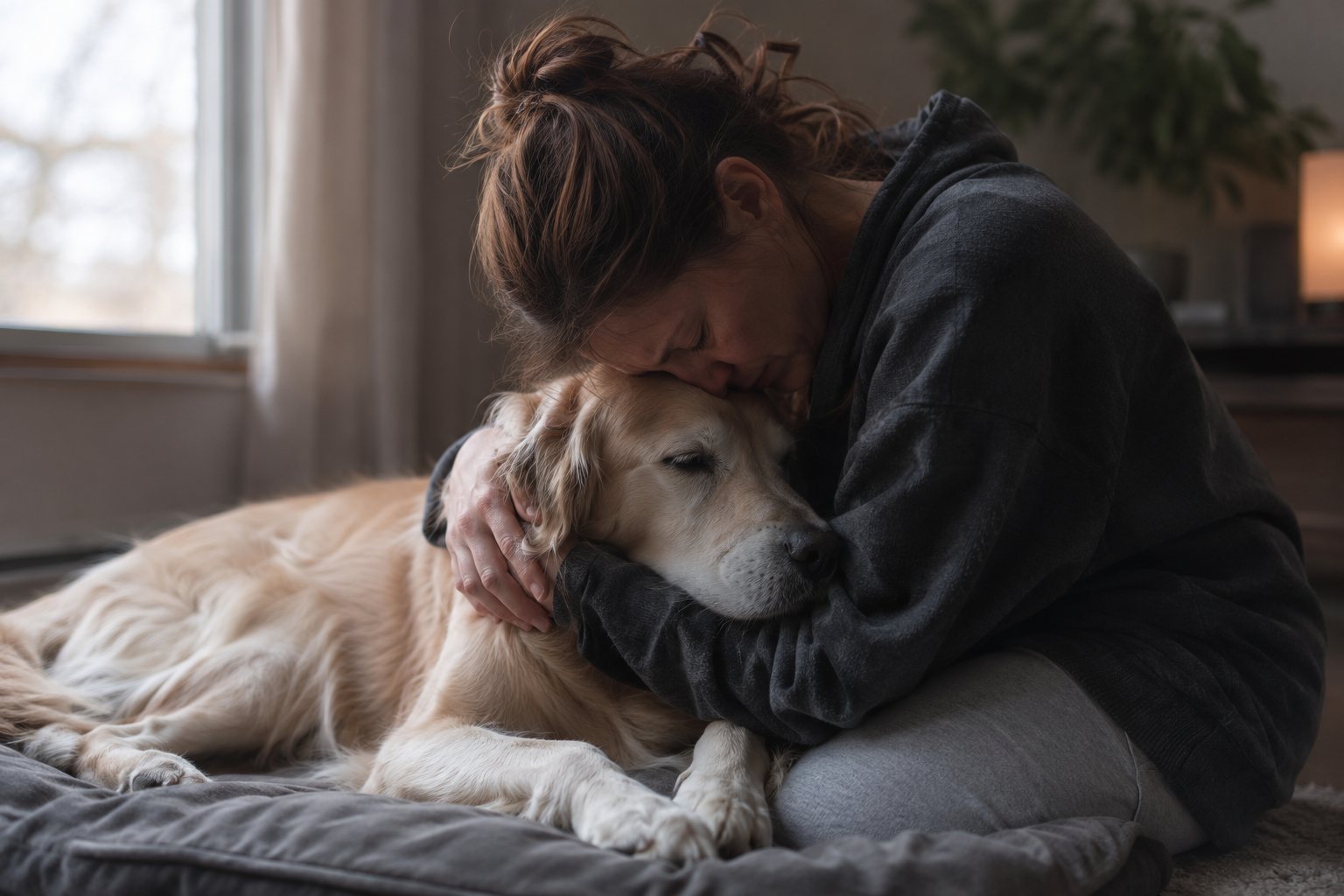
 A friend of mine — a perfectly composed, professionally accomplished woman — once told me that the only time in her adult life she had ever truly cried in public was when she lost her dog. She added, almost embarrassed: and it was worse than losing my father.
She said it like a confession. Like she expected me to disagree.
I didn’t disagree. I told her it was one of the most common things I hear from people I work with. And it isn’t a sign that she loved her dog more than her father. It’s a sign that the human-animal bond is one of the most uncomplicated relationships most adults ever experience — and that grieving its end deserves to be taken seriously.
This post is for the people who are grieving a pet right now and quietly wondering whether they’re broken because of how much it hurts. You’re not. The grief is real. The grief is normal. And the grief moves, eventually, even when it doesn’t feel like it ever will.
Why pet loss can hurt so much
Researchers have a term for this: disenfranchised grief. It refers to losses that society doesn’t fully acknowledge — losses that don’t come with bereavement leave, sympathy cards from coworkers, or rituals to mark the passing.
Pet loss is the prototypical example. Your office probably won’t give you three days off when your dog dies, even though that dog may have been the steadiest emotional presence in your daily life for fifteen years. Your friends may say I’m sorry once and then expect you to be over it. People may say it was just a pet without understanding that “just a pet” can be one of the most consistent love relationships a person ever has.
The grief is real. The lack of social acknowledgment is what makes it harder.
There’s also something distinctive about the human-animal bond that intensifies the loss:
Pets often live with us through entire chapters of our lives. A dog you got when you graduated college may be with you when you marry, when you change jobs three times, when you have children, when you move four times. They are the constant when everything else changes.
Pets witness us when we’re alone. In a culture where most adults have fewer close friends than previous generations, a pet may be the steady presence in the home — the one who is there when you cry, when you laugh at something stupid, when you eat dinner alone. Their absence creates an emptiness that’s hard to articulate.
The relationship is uncomplicated in ways human relationships rarely are. Pets don’t carry grudges. They aren’t disappointed in you. They aren’t keeping score. The unconditional nature of the love is part of what makes losing it so disorienting.
Pets are present for routines that no one else sees. The morning ritual of feeding. The evening walk. The way they sit at your feet while you work. These small moments accumulate into something that, when it ends, leaves a thousand small holes throughout the day.
What pet grief actually feels like
Pet loss grief can include any of the following — and most people experience some combination:
Crying that comes in waves. Long periods of normal function broken by sudden, intense tears. Often triggered by small things — finding a toy, hearing a name, seeing a similar pet on the street.
Physical symptoms. Tightness in the chest. Difficulty sleeping. Loss of appetite or unusual hunger. Headaches. Fatigue. Grief is physical.
Hearing or sensing the pet. Many people experience auditory hallucinations of their pet — hearing nails on the floor, a familiar bark, the sound of a feeding bowl. These are normal and typically pass within weeks to months.
Looking for them at familiar times. Reaching out at 5pm because that’s feeding time. Glancing at their bed when you walk past it. Expecting them at the door. The brain doesn’t update routines as quickly as logic does.
Anger. At the disease. At the timing. At yourself. At your veterinarian. At nothing in particular. Grief often presents as anger before it presents as sadness.
Guilt. Should I have noticed sooner. Should I have done more. Should I have done less. Should I have been there. Was the timing wrong. Almost universal, almost always misplaced.
Withdrawal from social contact. Grief is exhausting, and the energy required to maintain a normal social presence can feel impossible.
Difficulty concentrating at work. Particularly in the first weeks. Grief takes cognitive bandwidth.
Vivid dreams. Often of the pet healthy, happy, or themselves again.
Sudden waves of crying months later. Triggered by anniversaries, smells, songs, or nothing. Grief surfaces unpredictably for a long time.
All of this is normal. None of it means you are grieving wrong.
The “stages” of grief — and why they don’t really happen in stages
The Kübler-Ross stages — denial, anger, bargaining, depression, acceptance — are widely cited but widely misunderstood. They were originally described to capture experiences of dying patients, not bereaved survivors. And they are not, in any rigorous sense, stages.
Modern grief research suggests that grief is non-linear. You may experience all of those emotions, but rarely in order, rarely once each, and almost never on a schedule. You can be at “acceptance” on Tuesday, “anger” on Wednesday, “depression” on Friday, and back at “denial” on Saturday.
This is normal. It does not mean you are stuck or broken. It means grief is a wave function, not a checklist.
How long does pet grief last?
The honest answer: longer than most people expect, and longer than society allows.
The acute, daily-disruptive phase of grief typically lasts 3 to 12 weeks for most people. That’s the period of unpredictable crying, difficulty concentrating, sleep disturbance, and the daily ache of absence.
After that, grief typically transitions to a less acute but persistent presence in the background. It surfaces around anniversaries. It comes during quiet moments. It softens over months and years but rarely disappears entirely.
Most people find they can talk about their pet without crying somewhere between three months and a year after the loss. Some take longer. Some take less. None of these timelines are wrong.
If after about 12 to 16 weeks you’re still finding daily life seriously disrupted — significant work impairment, withdrawal from relationships, persistent sleep or appetite changes, increasing rather than decreasing distress — professional grief support is worth considering. Not because something is wrong with you, but because grief sometimes benefits from skilled help.
Practical coping strategies that actually help
Some things that consistently help people move through pet grief:
Allow yourself to grieve. Don’t perform okay-ness for other people. Don’t bury the grief to make others comfortable. Cry when you need to cry. The grief that gets expressed moves through. The grief that gets suppressed lasts longer.
Talk to people who understand. Find at least one person in your life who treats your grief as legitimate. If you don’t have someone, find a pet loss support group (free ones exist, many run by veterinary schools or animal welfare organizations).
Memorialize in some way that feels meaningful. A photo album. A planted tree. A memorial donation. An urn on the mantel. A story written about them. The act of memorializing helps move grief from raw to integrated.
Maintain routine where you can. Sleep. Eat. Move your body. Get sunlight. The body’s basic needs don’t pause for grief, and tending to them helps the body process emotional load.
Consider taking a walking route different from your pet’s route, at least temporarily. Some places carry too much association in early grief. It’s okay to vary the routine until those places feel approachable again.
Be patient about a new pet. Some people find that bringing a new pet into the home soon after a loss helps. Others find it disrespectful to the lost pet, or that it crowds out grief that needed space. There’s no wrong answer; there’s only your specific situation. Don’t let well-meaning friends or family rush you in either direction.
The guilt of euthanasia decisions
One specific form of pet grief deserves direct address: guilt about euthanasia.
Many families who have made the decision to euthanize a pet — even after months of careful thought, expert consultation, and clear evidence that it was the right choice — find themselves haunted by did I do it too soon? Did I do it too late? Did I do it for me or for them?
Here’s what veterinary research consistently shows: families who choose euthanasia for pets with terminal illness or significant suffering are almost always making a humane, loving decision. The “too soon” and “too late” worries are part of grief, not a real reflection of the decision quality.
If your pet was suffering, or close to it, and you helped them go peacefully — you didn’t fail them. You honored the trust they placed in you their whole life.
The guilt may visit you anyway. It does not mean you did anything wrong.
Resources
If you need more support than friends and family can provide, several resources exist:
- ASPCA Pet Loss Hotline: (877) 474-3310. Free, confidential support.
- Cornell University Pet Loss Support Group: Operated by Cornell College of Veterinary Medicine, with online and phone-based options.
- Pet Loss Professionals Alliance: Maintains a directory of professionals trained in pet loss grief.
- Books worth reading: The Loss of a Pet by Wallace Sife is widely recommended. Goodbye, Friend by Gary Kowalski is gentler and shorter.
If you’re in the immediate aftermath of a loss and looking for someone to talk to, the ASPCA hotline is staffed by trained grief counselors and is free.
A note about disenfranchised grief in the workplace
If you find yourself trying to function at work while grieving a pet, and feeling like no one around you understands the weight of it, here’s what I sometimes suggest to clients:
Take what time you can take. Some employers offer bereavement leave for pets explicitly; some allow personal days that don’t require justification; some are simply more flexible than you expect if you ask.
If you can’t take days off, take small accommodations — a quiet workspace, a longer lunch, leaving on time for a few weeks. Don’t feel obligated to perform unaffectedness.
And if a coworker has just lost a pet, take it seriously. A simple I’m so sorry. They mattered is often more meaningful than people expect.
One more thing
The grief is the price of having loved them. That price is worth paying. The fifteen years of small joys — the morning greetings, the trust, the warm presence, the unconditional love — would not have happened without the eventual cost of losing them.
If you’re grieving right now, you loved well. That’s the thing that mattered. The grief is what comes next, and it does eventually settle into something gentler, even if it never fully leaves.
You’re not broken. You’re grieving. Those are different things.
FAQ Section
How long does grief over a pet last? The acute phase typically lasts 3 to 12 weeks. After that, grief usually transitions to a quieter, persistent presence that softens over months and years but may surface periodically. Most people can talk about their pet without crying somewhere between 3 months and a year after the loss. There is no “right” timeline.
Is it normal to grieve a pet more than a person? Yes. The human-animal bond is uniquely uncomplicated, and pets often live with us through entire chapters of life. Grieving a pet more intensely than a person is not a sign of disordered grief — it’s a recognition of what that specific relationship meant.
Why do I feel guilty about my pet’s death? Guilt is one of the most common features of pet grief, especially after euthanasia decisions. It’s almost always misplaced. Families who make humane end-of-life decisions for pets with serious illness are almost always making the right choice. The guilt visits anyway, but it doesn’t mean you did anything wrong.
Should I get another pet to help with grief? This depends entirely on you and your specific situation. Some people find a new pet helps. Others find it crowds out grief that needed space. Don’t let well-meaning friends rush you in either direction.
Can pet grief cause physical symptoms? Yes. Chest tightness, difficulty sleeping, appetite changes, fatigue, and headaches are all common physical symptoms of grief. They typically improve over weeks. Persistent or severe physical symptoms warrant medical evaluation.
Where can I find a pet loss support group? The ASPCA Pet Loss Hotline (877-474-3310) offers free phone support. Cornell University and several other veterinary colleges run free pet loss support groups, many with virtual options. Local animal welfare organizations sometimes host in-person groups.
Is it okay to cry months after losing my pet? Yes. Grief surfaces unpredictably for a long time — often years. Anniversaries, smells, songs, photos, or nothing in particular can trigger renewed grief. This is normal, not a sign that you’re stuck.
Kindest Farewell
Phone: (203) 451-5616


