
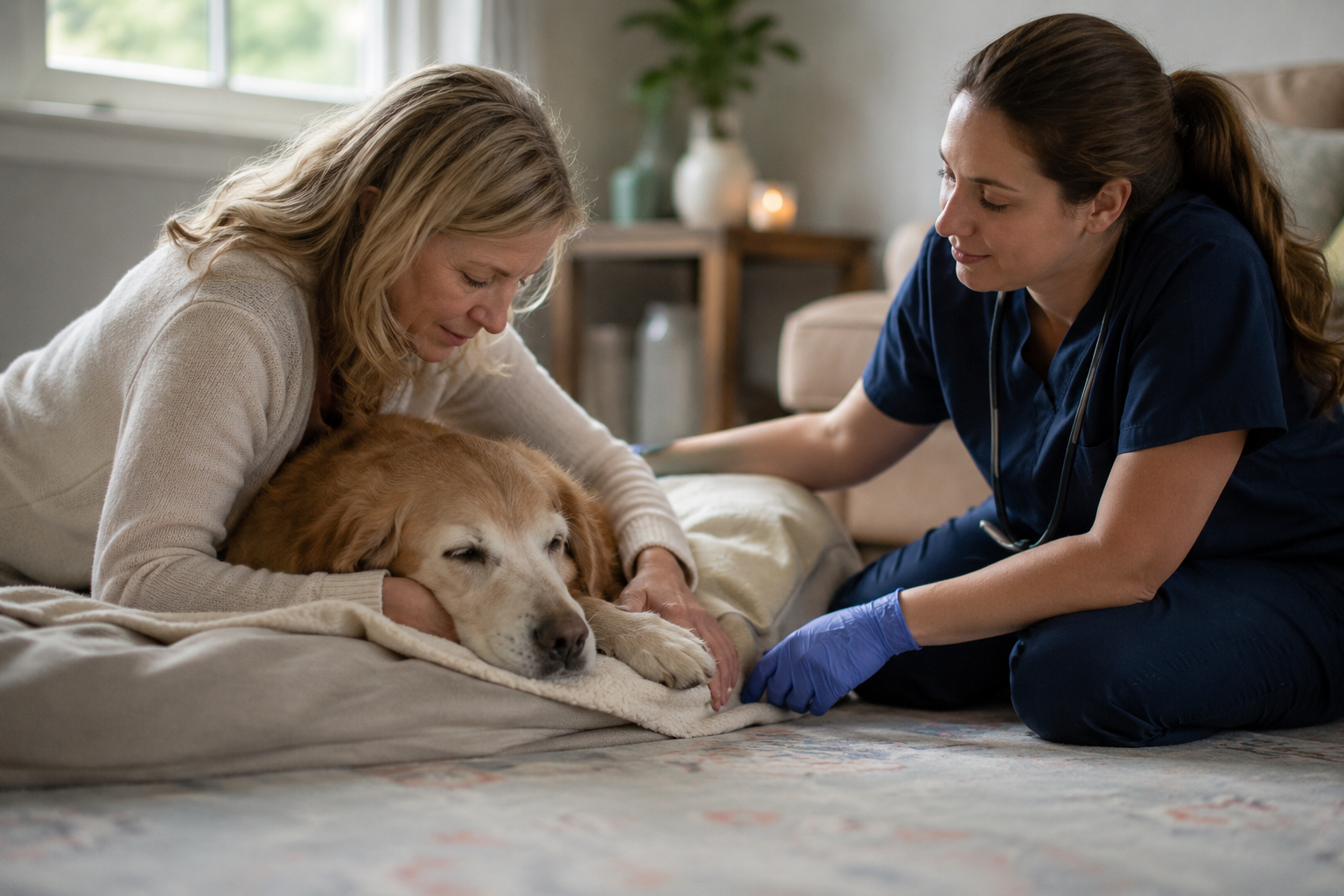
Most families have never been through this before. They’re trying to make a profound decision while having no idea what the actual experience will look like, and no one to walk them through it before it happens.
This guide is meant to fix that.
What follows is a clear, honest description of what happens during an in-home pet euthanasia visit. Not a sales pitch. Not a sanitized version. Just what to expect — in the order it happens — so that when the day comes, nothing about the process surprises you.
Why families increasingly choose in-home
Before walking through the visit itself, it’s worth saying a word about why in-home euthanasia has become the option more families choose for the pets they love most.
The reason isn’t sentimental. It’s medical and practical.
Pets at the end of their life are often weak, in pain, or anxious. The trip to a clinic — getting them into a carrier, the car ride, the waiting room, the unfamiliar smells, the strangers — adds suffering to the last hours of a life that has earned a peaceful ending. Many older pets find car travel deeply distressing even at the best of times. At the end of life, the trip can be the worst part of the day.
In-home euthanasia removes all of it. Your pet stays where they’re most comfortable, in the home they understand, with the people they love. There is no rush. There is no waiting room. There is no clinic schedule pressing against your last moments together.
That’s the difference. The medication is the same, the process is the same, the outcome is the same. But the experience around it is fundamentally different.
Before the visit: the booking call
The process usually begins with a phone call. For most families, this is itself a difficult moment — picking up the phone makes it real in a way that thinking about it didn’t.
The booking call typically covers:
- Your pet’s species, breed, weight, and condition
- The reason you’re considering euthanasia
- Whether you’ve already made the decision or are still considering
- Your address and timing preferences
- Any specific requests (who will be present, where in the home, special considerations)
- The fee and what’s included
- Aftercare options (cremation, retrieval, home burial considerations)
A good provider will not rush this call. They’ll answer your questions honestly, explain the process in advance, and make sure you understand exactly what to expect. If a service tries to schedule you in two minutes without inviting questions, that’s a signal worth heeding.
You’ll typically receive confirmation by text or email with the appointment time and any preparation notes.
Preparing your home and family
You don’t need to do much. But here’s what some families find helpful:
Pick the room or spot. Where will your pet be most comfortable? Their bed, the couch, the floor by the fireplace, the back porch, the back yard. There’s no wrong answer. Many families choose the place their pet has always slept.
Decide who will be present. This is your call. Family members, including children if you’ve decided that’s right for your family. Other pets in the household (more on this below). Close friends who knew your pet well. Some families want a small private gathering. Others want only one or two people. Both are right.
Think about meaningful gestures. Some families have a final meal of their pet’s favorite forbidden food (a hamburger, a slice of pizza, a piece of birthday cake). Some play music. Some take photographs. Some do nothing — just sit and be present. None of these are required. What matters is what feels right to you.
Have something soft and familiar. A favorite blanket. A bed your pet has used for years. The veterinarian will work with you wherever you choose, but a familiar surface is often where pets are most comfortable.
Prepare children, if applicable. If children will be present, an age-appropriate conversation in advance helps. Honest, simple language is best. (More on this in our post about talking to children about a pet’s death.)
The veterinarian’s arrival
When the veterinarian arrives, the pace immediately slows.
A good in-home euthanasia veterinarian doesn’t bustle in. They come in quietly, often introduce themselves softly, and take a few minutes to greet your pet — let your pet smell them, get used to their presence, settle. There’s no rush.
The veterinarian will sit with you, often on the floor or wherever you’ve chosen for the visit. They’ll review the basics: confirm your pet’s identity, briefly explain what’s about to happen, and answer any last questions. Paperwork is handled gently — usually a single consent form. Most providers handle the financial side either before the visit or quietly afterward, never as a centerpiece of the moment.
The whole arrival and conversation portion typically takes 10 to 20 minutes, depending on what you need.
The sedation
The first injection is a sedative.
This is the most important part of the visit, both medically and emotionally. The sedative is given by injection (usually in the muscle, sometimes under the skin), and within 5 to 15 minutes, your pet drifts into a deep, relaxed sleep.
Your pet feels no pain from this injection. Many pets barely react to it — perhaps a small flinch — particularly if they’re already weak. Within minutes, you’ll see the tension leave their body. Their breathing slows. Their muscles relax. For pets who have been in pain or anxious for a long time, this is often the most peaceful they’ve appeared in weeks or months.
This is also the moment when most families let the breath out they’ve been holding. Your pet is comfortable. They are not afraid. Whatever happens next, they’re already past suffering.
The veterinarian will give the sedative time to fully take effect. There is no rush to the next step. You can hold your pet, talk to them, lie next to them, take photographs, sit in silence — whatever feels right. Some families take 20 minutes here. Some take an hour.
The final injection
Once your pet is fully unconscious, the veterinarian administers the final injection. This is typically given intravenously — directly into a vein — for fast, smooth action. In most cases, the veterinarian will gently locate a vein in your pet’s leg.
Because your pet is fully sedated, they feel nothing.
The final medication acts quickly. Within about a minute, your pet’s heart will stop. The veterinarian will use a stethoscope to confirm.
What you may notice during this minute, depending on the pet:
- Slowing breathing. Your pet’s breathing will gradually slow and stop.
- Possible final breaths. Some pets take one or two slow, deep breaths in the final moments. These are reflexive and not signs of distress.
- Muscle relaxation. Bowel or bladder release sometimes happens — this is normal and expected. The veterinarian will have absorbent material in place.
- Eyes remaining open. Pets’ eyes typically remain open after passing. This can be unexpected to families who haven’t been told.
The veterinarian will tell you, gently, when your pet has passed.
Time afterward
This is the part most families don’t realize is included.
There is no clock. You can stay with your pet for as long as you need. Some families take five minutes; others take an hour or more. The veterinarian will step away, give you space, and wait until you’re ready.
When you’re ready, the veterinarian will help you with the next steps you’ve chosen — including aftercare. If you’ve arranged for cremation or retrieval, the veterinarian will handle the gentle transport of your pet’s body. If you’re keeping your pet at home (for example, for a planned home burial in jurisdictions where this is permitted), the veterinarian will leave your pet in your care.
Some families want a paw print impression or a lock of fur taken before the veterinarian leaves. Most providers offer this either as part of the visit or on request.
What’s different about in-home from clinic euthanasia
People often ask whether the medication is the same. It is. The process — sedation followed by a final injection — is identical to what happens in a veterinary clinic. The peaceful passing is the same.
What’s different is everything around it:
- No carrier, no car ride
- No waiting room, no other patients, no fluorescent lights
- No appointment running late or being rushed
- No exam table, no clinical environment
- Time afterward, with no one waiting for the room
- Family members and other pets able to be present in ways that clinics rarely accommodate
- The choice of where in your home
That’s the whole difference. The medical care is the same. The experience is profoundly different.
Cost and what’s typically included
In-home pet euthanasia in most US markets ranges from approximately $400 to over $1,000, depending on geography, service tier, and what’s bundled.
A typical visit fee includes:
- The veterinarian’s travel
- Sedation and final medications
- The visit itself (usually 45 minutes to over an hour)
- Confirmation of passing
- Time with your pet afterward
Some providers include cremation; others price it separately. Aftercare arrangements (urns, paw prints, retrieval) are sometimes additional. A clear, transparent provider will tell you exactly what’s included before the visit, with no surprises afterward.
Our flat-fee structure is $600 throughout most of our Connecticut and New York service area, with cremation priced separately so families can choose what’s right for them.
The most important thing
The single most common thing I hear after a visit, from families who were dreading it, is: that was so much more peaceful than I expected.
You’re not signing up for trauma by choosing this. You’re giving your pet the gentlest possible ending in the place they’ve always understood as home. The hard part is the decision before the visit. The visit itself is, almost without exception, far more peaceful than the dread suggests.
If you have questions about how this would look for your family, you can call us anytime at (203) 451-5616. There’s no pressure. We’re glad to walk you through it before you decide anything.
FAQ Section
How long does in-home pet euthanasia take? Plan for about an hour, though there’s no clock. The arrival and conversation typically take 10 to 20 minutes. The sedation takes another 10 to 20 minutes. The final injection takes about a minute, followed by however much time you need afterward. Some families take 30 minutes total; others take 90 minutes. The visit moves at your pace.
Will my pet feel any pain? No. The first injection is a sedative — many pets barely react to it. Once they’re unconscious, the final injection is given. Your pet feels nothing from that point forward. Many families describe their pet looking more peaceful during the sedation than they have in weeks.
Can my children be present? Yes, if your family decides that’s right. Many veterinarians who specialize in in-home euthanasia are comfortable with children present, will talk with them at their level, and will work with whatever role your child wants to take. Honest preparation in advance helps. There’s no universally right answer about whether children should be present — it depends on the child and the family.
Should other pets be in the room? Often, yes. Surviving pets sometimes grieve more profoundly when their companion simply disappears than when they’re allowed to be present. Some pets sniff or briefly investigate after; others observe quietly. The veterinarian will follow your lead on this.
What if I change my mind during the visit? You can. A reputable in-home euthanasia veterinarian will not pressure you. Sedation can usually be paused or slowed if you need more time, and in some cases the visit can be rescheduled. The decision is yours.
What happens to my pet’s body afterward? Several options exist: private cremation (with ashes returned), communal cremation (no return), aquamation (a water-based alternative to flame cremation), or home burial where local ordinances permit. Most providers can handle the gentle transport of your pet’s body to a cremation partner. You’ll typically discuss these choices in advance, so nothing has to be decided in the moment.
Is in-home pet euthanasia more expensive than going to a clinic? Generally, yes — by some amount. Clinic-based euthanasia is typically $200-$500. In-home euthanasia is typically $400 to $1,000+, depending on geography. The added cost reflects the veterinarian’s travel, the dedicated time for your visit, and the unhurried nature of the experience. Many families find the difference worthwhile for what their pet receives.
Kindest Farewell
Phone: (203) 451-5616


