
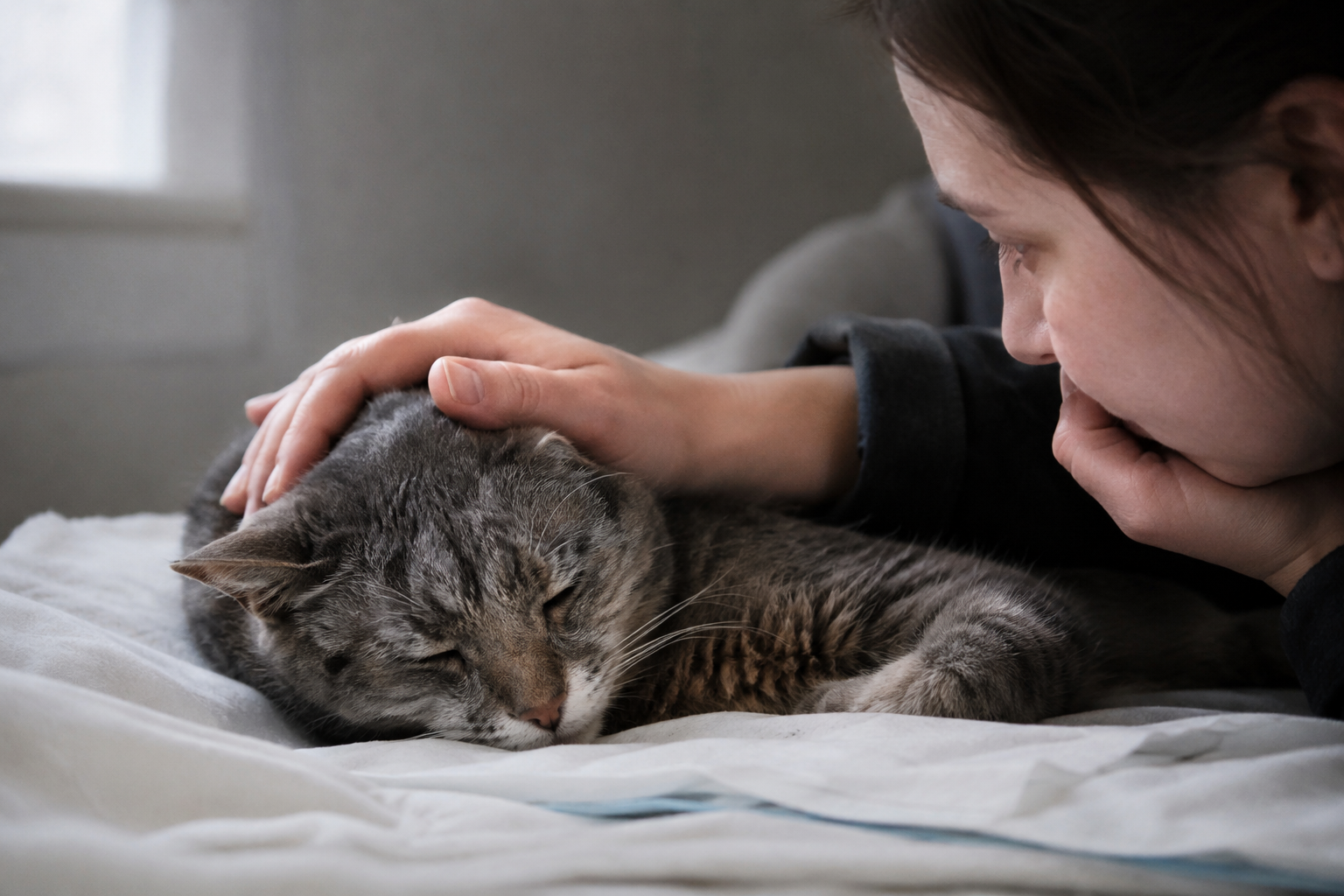
The hardest thing about end-of-life decisions for cats isn’t the decision. It’s the visibility problem.
Cats are not stoic the way dogs are stoic. They’re stoic in a different, more frustrating way — they actively conceal weakness because their evolutionary wiring tells them that visible illness invites predation. A cat who is genuinely sick will, on a good day, look almost normal. A cat who is dying will sometimes purr through their last evening.
This is the central problem cat owners face. By the time the signs are obvious to you, your cat has likely been compensating for weeks or months. The window between “she seems off” and “this is serious” can be vanishingly short — not because the illness is fast, but because the disguise was good.
I write this not to alarm you. I write it because most of the cat owners I work with feel they should have noticed sooner, and almost none of them could have. The fact that you’re asking this question now means you’ve seen past the disguise. That’s the work. Now we figure out what you’re actually seeing.
What’s actually different about cats
A few differences worth understanding:
Cats often hide. Healthy cats hide too — that’s not the signal. The signal is hiding more, hiding in new places, hiding even when their favorite person is around, hiding for hours longer than they used to.
Cats stop grooming. A cat who has groomed themselves to glossy perfection for fourteen years and now has matted fur on their back is communicating something. The stop-grooming sign is one of the most reliable indicators that a cat’s quality of life has dropped meaningfully.
Cats change their litter box behavior. Eliminating outside the box, struggling to climb in or out, urinating in painful or unusual postures — these often signal pain, kidney decline, or cognitive changes.
Cats become quiet differently. A cat who was always vocal and is now silent may be conserving energy. A cat who was always quiet and is now vocalizing — particularly at night — may be in pain or experiencing cognitive dysfunction.
Cats lose interest in heights. Cats who can no longer jump to their favorite spot, or who stop trying because the attempt has become too hard, are showing you a meaningful change. The world contracts vertically before it contracts horizontally.
These changes are subtle individually. Together, they tell a story.
The conditions that bring cat owners to this question
Most cats who come to end-of-life decisions are dealing with one of several common conditions:
Chronic kidney disease (CKD) is the most frequent. It progresses slowly but predictably, with appetite loss, weight loss, increased thirst and urination, and eventually nausea and dehydration becoming dominant.
Hyperthyroidism, when untreated or no longer responding to treatment, causes weight loss, restlessness, and eventual heart strain.
Cancer, including lymphoma, mast cell tumors, and various carcinomas, presents differently in cats than in dogs and is often discovered later.
Inflammatory bowel disease and gastrointestinal lymphoma cause chronic vomiting, diarrhea, and weight loss that gradually wear a cat down.
Diabetes mellitus, particularly when complicated by ketoacidosis or unresponsive to insulin.
Cardiomyopathy (especially HCM), with or without symptomatic heart failure.
Cognitive dysfunction syndrome in older cats — sometimes mistaken for “just getting old.”
Each of these has its own arc. Each warrants a different conversation about quality of life. None of them are well served by waiting for a single dramatic moment.
The HHHHHMM scale, applied to cats
The HHHHHMM Quality of Life Scale (developed by Dr. Alice Villalobos) works for cats with a few translations:
Hurt — Is your cat showing signs of pain? Squinting, withdrawal, hiding more than usual, posture changes (hunching, sitting in unusual positions), reluctance to be touched in places that used to be welcome.
Hunger — Is your cat eating? Cats can survive on remarkably little for short periods, but appetite loss that lasts more than a few days, especially with weight loss, is meaningful. Force-feeding a cat who actively refuses food is rarely a kindness.
Hydration — Cats with kidney disease often drink more, then less as the disease progresses. Are they hydrated? Is your cat showing signs of dehydration despite their drinking?
Hygiene — Has grooming stopped or become inadequate? Is the litter box being missed? Are they soiling themselves?
Happiness — Does your cat seek you out? Greet you? Engage with the household? Or have they retreated to a permanent hiding spot, no longer interested in what’s happening around them?
Mobility — Can your cat get to their food, water, and litter box without struggle? Can they jump or climb where they used to? Are they falling?
More good days than bad — When you look at the past two weeks honestly — not the past three weeks, not the period before the latest decline — are the good days winning?
A total score under 35 of 70 is generally considered an indication that quality of life has declined to a point where euthanasia should be seriously considered. The number is less important than the conversation. Going through each category honestly is the actual work.
“But she’s still eating”
This is the sentence I hear most often from cat owners who are not yet ready.
She’s still eating. He still purrs when I pet him. She still comes to bed at night.
These are real observations. They’re also things cats do almost reflexively, often well past the point where their quality of life has eroded. A cat can purr while in pain. A cat can eat one bite of tuna and refuse everything else. A cat can come to bed because the bed has been their place for fifteen years and the habit is older than the illness.
The question isn’t whether your cat is doing one or two familiar things. The question is whether your cat is still themselves — whether the cat in front of you now resembles the cat you’ve known.
If the answer is no, or no most days, that matters more than any individual sign.
The role of pain you can’t see
Pain in cats is one of the most under-recognized issues in companion animal medicine. Cats with arthritis — which is far more common than most owners realize, affecting most cats over twelve — typically show their pain through subtle behavioral changes rather than obvious limping. They jump less. They sleep more. They become “grumpier.” They withdraw.
Cancer pain, kidney disease nausea, dental disease, and chronic inflammation all produce similar quiet, easy-to-dismiss signals.
If your cat has been “just getting older” for a while and is now markedly different — quieter, more withdrawn, less themselves — there’s a high likelihood that uncontrolled pain or chronic discomfort is part of what you’re seeing. A veterinary visit, ideally with someone who specializes in older cat care or end-of-life work, can help identify what’s actually happening underneath.
Letting a cat die naturally at home
Some families want to know whether they can simply let their cat pass naturally. The honest answer is: rarely peacefully.
A cat who is genuinely at the end of their life, without intervention, often experiences a final period that involves dehydration, hunger, breathing difficulty, or seizure activity. Some cats do pass quietly in their sleep. Many do not. The romantic idea of a peaceful natural passing rarely matches the medical reality.
This is part of why euthanasia exists as an option for our pets — not as a failure of love, but as a final act of care that prevents the kind of distress that “natural” deaths often involve.
When a consultation makes sense
If you’re seeing some of the signs above and you’re not sure where you are on the timeline, an in-home consultation with a veterinarian dedicated to end-of-life care can give you genuine clarity.
The visit is in your home, in the place your cat is most comfortable. The veterinarian can see your cat behave the way they actually behave — not the masked version that shows up at a clinic. They can tell you, with experience and honesty, where your cat is. And they can build a comfort plan if there’s still good time, or help you plan a peaceful goodbye if there isn’t.
You’re not signing up for euthanasia by scheduling a consultation. You’re giving yourself information.
The kindest possible ending
Cats don’t ask for elaborate goodbyes. What they want is to be warm, comfortable, and with the people who have loved them.
If you decide the time has come, an in-home euthanasia lets you provide all of that. Your cat doesn’t have to spend their last hours in a carrier, in a car, or in a clinic exam room. They can be on their bed, in your lap, in the spot of sun by the window where they’ve watched the world go by.
Whatever you decide, the love that brought you to this question is the same love that will see you through it.
FAQ Section
How can I tell if my cat is in pain? Cats hide pain extraordinarily well. The most reliable signs are behavioral: hiding more than usual, stopping grooming, changes in litter box habits, decreased jumping or climbing, withdrawal from family, hunched posture, or reluctance to be touched. Vocalization changes — either new vocalizing or unusual silence — also matter.
Why has my cat stopped using the litter box? Litter box changes can signal kidney disease, urinary tract issues, joint pain (making it hard to climb in), cognitive dysfunction, or general decline. It’s a meaningful sign that warrants veterinary evaluation.
Is hiding always a sign that a cat is dying? Not always — cats hide for many reasons. But hiding in new places, hiding more than usual, or hiding even when favorite people are around can indicate that a cat is feeling unwell. Combined with other signs, it’s significant.
How long do cats with kidney disease live? This depends heavily on the stage at diagnosis and how well the cat responds to treatment. Cats diagnosed in early stages can live for years with good management; cats in late-stage disease may have weeks to months. Quality of life, more than time, is what matters at the end.
Should I let my cat die naturally at home? While some cats do pass peacefully, “natural” deaths in cats often involve discomfort — dehydration, breathing difficulty, or pain that families weren’t expecting. Euthanasia, when offered with care, is typically the more peaceful option for cats at the end of life.
What does the end of life look like for a cat? Late-stage signs typically include profound weakness, loss of appetite and interest in water, withdrawal, possible breathing changes, and sometimes seizures or distress. The progression varies by underlying cause.
Can my cat be euthanized at home? Yes. In-home euthanasia is widely available and is generally considered the most peaceful option for cats. There’s no carrier, no car ride, no clinic stress — your cat stays in their familiar environment.
Kindest Farewell
Phone: (203) 451-5616


